Thursday, September 10, 2015

With Flying Colors

I'm glad to be getting back into this after not writing in such a long time - the end of summer flew by and I transitioned right into football training camp in the blink of an eye with little to no time for blogging.

Now that I'm back in school mode, I'm hoping that I can be more regular with my writing. Unfortunately, being back at school means that I'll also be flying less often than I was over the summer due to my football and class schedule. Thankfully, I have some things up my sleeve from the past that I haven't written about yet to hold me over until I can fly again.
-----------------------------------------------------------------------------------------------------------------------
With that said, back to my previous post about my checkride. Everything went (almost) according to plan! I ended up passing and receiving my license. My examiner (Gail - one of the best in the Chicagoland area - email me for details) was fair and thorough in her examination, which I was very happy with.

The ground portion of the exam was everything I had expected. My instructor gave me a packet that the flight school routinely uses for checkrides which contained almost all of the questions that I was asked by Gail.

The only question I really wasn't sure of was "How often are TAF (Terminal Area Forecasts) reports issued/valid for/when are they effective." For those not familiar with a TAF, it's a forecast broken down by blocks of hours (weather dependent) that shows the winds, cloud cover, visibility, precipitation (if any), amongst other weather phenomena. I knew how long they were valid for (24 hours), but wasn't sure about how many times they were issued per day or when they went into effect. An example (plain on the left and decoded on the right) can be seen below.


During the flight portion of my checkride, Gail ran through everything outlined in the Practical Test Standards (PTS) set by the FAA. Here, I had one slip up as well, which was thankfully forgiven.

For the checkride, one is required to perform a short field landing, as well as a soft field (grass, gravel, etc) landing. Gail had me head to the Joliet airport (JOT) which I had been to before, but I was surprised by the choice as it was a hot day and the runway was relatively short - 2900 ft. Thankfully, the winds were light and straight down the concrete runway.

First, she had me come in for a short field landing, where you're not allowed to land more than 200 ft beyond an examiner-specified point. On the approach, I came in a bit high and landed right at, if not a little past the 200 ft limit. Thinking I was going to get failed on the spot, I was relived when she told me that it would count as my soft field landing instead since the touchdown itself was so smooth. We then performed a short field takeoff and came around for another attempt at the short field landing, which I executed to perfection this time.

After heading back to Lewis (LOT), I knew I wasn't out of the woods yet and that any mistake I made could result in a failed checkride. I checked and double checked everything as I came in for the final landing of the day - nailed it.

I had this feeling on the taxi back to parking that I had passed, but I had to hear those magic words from her first. As I parked the plane precisely on the yellow T and shut down the engine, she said, "Jim, this is a no-brainer decision for me. Congratulations."

I was ecstatic - but she also asked me, "Is there anything you would have done differently or could have done better?" I, of course, wasn't perfect and said that I could have had better control of bank on my steep turns, amongst a couple other little things (I'm a perfectionist).

What made the moment even more special for me was seeing my parents on the ramp as I parked the plane. For most, if not all, of my training, they have both had a very hands off approach, only coming to the airport once before this occasion and just letting me go about my business by myself. Having them there to share in my joy made the moment that much better.

--------------------------------------------------------------------------------------------------------------------------

It was finally done! I had finally earned and achieved my Private Pilot License, which will last with me forever. With this newly acquired freedom, I couldn't wait to take my family and friends flying and show them the unique and jaw-dropping perspective that I am privileged to see every time I go up. In my next post, I'll talk about the couple flights that occurred after getting my license, as well as what I plan to do with my license in the future.


SPECIAL SHOUT OUT: My instructors and mentors throughout the process of earning my license: CFI's Art, Hal, James, and Joe! Thank you for all you did, and continue to do, in making me the pilot I am today.

Thursday, July 30, 2015

Checkride Prep

Unfortunately, I haven't had time to write while the process was going on - won't waste my time explaining why, but I'd like to take you through the process of preparing for my checkride after the mock checkride with my instructor.

The next step, as mentioned in my previous post, involved taking a mock checkride with the head instructor at the flight school I fly out of. The ground portion, consisting of several questions on airspace, weather, aircraft systems, and other subjects such as aerodynamics, took about 2 hours and I passed with flying colors.

Next came the flight portion, also known as the practical test, where my skills in actually piloting the bird were tested. I was put through a series of maneuvers - steep turns, S-turns about a line, turns around a point, power on (takeoff) and power off (landing) stalls - as well as different landings (short and soft field).

The maneuvers went  relatively well and I passed that portion. However, a speed bump was hit during the process. In the manual written by the FAA for the actual checkride, stalls are able to be performed with either level wings or (essentially) 10 degrees of bank, the latter of which is obviously a bit tougher. On the mock checkride, I was asked to do a power on stall with 10 degrees of bank, which I had not previously practiced - my instructor and I had only done wings level stalls. Having never done this before, this meant that I would be practicing them with my instructor before the checkride.

Other than the stalls and a few other minor errors (not referencing the airport diagram after landing, missing a step in an emergency procedure, to name a couple), the ride went well and I was told by the instructor that I passed! On to the next...

In the stall practice with my regular instructor a week before the checkride, things didn't go as well as they previously had. For whatever reason, I was having trouble getting the hang of the power on stalls that day and nearly entered a spin (can be fatal) once or twice, but was able to recover on my own. After about 7 stalls, I finally had some of my confidence back, but it wasn't at the level that it had been at previously. As a result, I knew I'd have to go up another time before the checkride to make sure I was 100% confident in what I was doing, because you only get one chance at acing the maneuvers.

During the week between that flight and the checkride, I spent ample amounts of time preparing for the ground portion of the checkride - preparing my flight plan, knowing the all of the aircraft systems, etc - making sure that I wouldn't miss a beat when the time came.

The day before the checkride, I went up with my instructor once more and totally aced my stalls - felt totally comfortable and confident doing them. We also practiced ground reference maneuvers (S-turns, turns about a point) and emergency procedures as well - very confident there, too. I was finally 100% ready for my checkride!

In the next post, more to come on how the ride went!


Monday, July 6, 2015

Last Leg

Whether flying, driving, sailing - if there are stops or points as you go through your journey, the time spent traveling between stops can be considered a 'leg.' Believe it or not, the same can apply to my flight training 'journey.'

If one were to analyze my journey through this process of acquiring my pilot's license, it could easily be broken up into different legs:

  1. Training at the end of last summer (2014)
  2. Training over winter break
  3. Training over spring break (almost too short to even be considered a leg...)
  4. Training during this summer (2015)
If we were to analyze even further, the training this summer could be broken down even further:
  1. Completing my required training hours
  2. Checkride prep/checkride
After exactly a month of being home from school, and mainly flying one or two days per week because of work, that first sub-leg of the fourth leg of my journey is complete. From here on out, it's all about prepping for my checkride with a Designated Pilot Examiner, or DPE. 

This prep will involve hours upon hours of study at home for the oral exam, as well as a small amount with my instructor to make sure I know everything. In terms of flights, I have two flights left at the very least; one with my instructor to put me through all the standard maneuvers/procedures, and if I pass that then I head on to the phase check flight (basically a mock checkride) with the head instructor. 

Then if I pass the mock checkride, I'll be able to go up with the DPE for my official checkride. 

It'll be a stressful process for sure, but one that I can't wait to finish - I know it'll be very rewarding in the end...


**update**

'Passed' the ground with my instructor...on to the mock checkride with the head instructor!

Stay tuned

Tuesday, June 9, 2015

It's Been A While...

I know it's been a almost 2 months since I last posted, but I'm glad to be back here writing. Spring semester of my sophomore year at college has thankfully come and gone, and I'm happy to be back home for the summer writing, working, and - most importantly - flying.

In the couple weeks since I've been home, I've been able to fly three times - mainly due to scheduling issues related to work, but everything has worked itself out.

Since I had last flown a couple months back in March, I had to go up with an instructor again to make sure that my flying was still sound. In those couple months, the airport that I usually fly out of (Clow Int'l - 1C5) has been temporarily closed for the summer. Clow is getting a huge facelift with a brand new, wider, better-lit runway which will definitely make landing amongst houses and a shopping center a bit easier.

With the runway closed at Clow, all operations have since been moved to the Lewis Univ. Airport (KLOT) 5 miles to the south. Lewis, unlike Clow, has two crossing runways - a NNE/SSW runway and an E/W runway - which make landing in crosswinds much easier than the one N/S runway at Clow.

My first flight with the instructor was very uneventful. Frankly, I thought that the high winds (12-18 knots, or 14-21 MPH) would make things a little more turbulent than normal, but there were hardly any bumps at all. We took off from Lewis and headed towards DuPage Airport (KDPA) for a touch-and-go. DuPage had a tower, which helped me brush up on my communication skills, and it was on the way to our next destination, DeKalb Municipal Airport (KDKB). While at DeKalb, we did another touch-and-go, and headed back to Lewis.

On the way back to Lewis, my instructor had me navigate direct to the Joliet VOR (JOT) to make sure that I could still track a VOR radial (more info on that from my earlier post HERE), which went well. He also had me practice an engine failure, where he pulled back on the throttle suddenly and I had to run through my "engine out procedures," shown below:
  1. Pitch for best glide speed (68 knots)
  2. Fuel Shutoff Valve - ON (with the valve ON, fuel flows to the engine - interesting logic...)
  3. Fuel Tank Selector Valve - BOTH (fuel comes from both left and right tanks)
  4. Auxiliary Fuel Pump - ON
  5. Mixture - FULL RICH (makes sure that as much fuel is entering the engine as possible)
  6. Ignition Switch - BOTH (or START if propeller has stopped)
From there, there are different checklists based upon whether or not the engine starts back up or not, which I'll save you the reading of for now. 

...In our case here, the engine obviously "restarted," since all my instructor did was cut back the power and not shut off the engine, and we carried on our way towards Lewis. 

Landing at Lewis went well, like the others, and the flight as a whole was uneventful.

Just about level at 2,500 ft, cruising a little less than 120 knots over rural Illinois


Once I have my license (knock on wood), I plan on taking some of my passengers in the Chicago area to see the lakefront and fly over the city. In order to know the ropes of flying the lakefront, I flew up the next day with an instructor to practice whats called a "lakefront transition."

From Lewis, we flew East-Northeast, being sure to stay south of Midway Airport and their traffic. In order to complete this transition, constant contact with Midway Tower is necessary, as you are flying through their airspace for most of the flight. Once we flew past Midway, we reached the lakefront at about 55th St, flew over the University of Chicago, and turned North along the lake. Just to give you an idea of how high up we were, we were flying at 1,700 ft above sea level, or about 1,000 ft above the ground - this meant that the Sears (Willis) Tower soared more than 700 ft above our plane. 

After flying by downtown and seeing Soldier Field, Millenium Park, and Navy Pier from above, we continued North along the shore until we came to Northwestern University and the Bahai Temple in Evanston. If one was to drive from Lewis Univ. To Northwestern, it would take about an hour and a half. Flying, it took us a mere 23 minutes to travel between the two points.

After we reached Northwestern, we turned around and headed southbound along the lake back towards the city. This time, we weren't able to fly within 5 miles of the White Sox game (TFR, or temporary flight restriction) and had to head South about out a mile or two over the lake before heading West toward Midway again.

View through the propeller of Downtown Chicago from the North Side with Montrose Harbor to our immediate left

On our way back West, we made a low approach over Midway (basically buzzing the field). We were about 150-200 ft above the field going 130 knots (150 MPH) with the field and the houses below us. Personally, I can't decide what was cooler though...landing at Midway at night, or buzzing the field Top Gun style (kinda).


After that, we headed back to Lewis and concluded the flight. From this experience, I definitely learned a valuable skill that will come in handy when taking passengers up in the future, and I took in beautiful views as well.

------------------------------------------------------------------------------------------------------------------

The next flight involved getting certified by my primary instructor (who happened to be on vacation while I was flying the two previous times) for solo flight. Although I had done it before and accumulated approximately 9 hours worth of solo time, his endorsement for me to fly solo expires after 90 days, and that's just what happened to my last endorsement.

Before going up, he had me plan a cross-country flight from Lewis, which transitioned through the Chicago/Aurora (KARR) airspace, flew over DeKalb (KDKB), and into Chicago/Rockford Int'l (KRFD). Even though flights both ways were relatively smooth, we could see the forecasted puffy, white thunderclouds forming all around us. We knew that we would make it back to Lewis in time to beat out the storm, but at the same time it was spectacular to watch the storm grow around us. At the conclusion of the flight, I was finally certified to fly solo again.

As far as my training goes, I am almost at the end of the road. I hope to have my license by the end of the month, but we'll see how the weather and my work schedule hold up as the weather gets warmer and the days longer. Looking forward to when I can share more of my flying with you next time! Stay tuned...

Sunday, April 12, 2015

Spring Break Update

**Disclaimer: Wrote this a couple weeks back on my way back to school after spring break. Haven't been able to really publish until now because of school work...with that said, enjoy!**

Spring break 2015 has at last come and gone...and it's official! I completed my first solo cross-country flight. Before I was able to go on that flight though, I had to get checked out with my instructor first.

Early Saturday, we went up and practiced all of the required maneuvers, and they all went pretty well for my first time flying in two months. The only thing that I had a little trouble with was recovering from a stall, lowering the nose of the plane too much after the stall to try and gain airspeed to recover. In the process, I lost a bit more altitude than I should have and that's where I went awry. Don't worry though - after the initial stall recovery attempts, I completed the recoveries and was able to 'pass.'

After that early flight, I had some lunch and spent some time hanging around the airport, waiting for the winds to die down. As a student pilot, I have 'concrete' limits on things like wind, visibility, and cloud ceiling. The limits placed on me are 10 knots of headwind, 7 knots of crosswind, visibility of 8 miles, and cloud ceiling of 2,500 ft. On Saturday, the winds reported both at Valparaiso (VPZ) and Lewis University (LOT) were fluctuating just in and out of my limit range. At about 3:30, the winds fell within my limits both at Lewis and Valpo and I headed out!

My flight took me from Clow Airport (1C5) to Valparaiso/Porter County Municipal Airport (VPZ) in Northwest Indiana. The FAA regulations say that a cross-country flight is a flight that's over 50 nautical miles (straight line distance) one way from departure to destination. Thankfully, the straight line distance here is 52.6 miles - just far enough outside the limits where it'll work for me, and I won't waste my time going too far.


My route was not a straight line from 1C5 to VPZ for one main reason - I had to steer clear of the Chicago Midway airspace (the solid magenta rings). In order to avoid this, I headed along a more southerly route and overflew Lansing Municipal Airport (IGQ) and then headed direct to Valpo, By the time I actually got to Valpo, winds were very light (4 knots) and I had possibly my smoothest landing to date - flights both ways also had no turbulence, which made for an awesomely smooth ride. Very enjoyable.

Below are some pictures that I took while cruising over to VPZ...
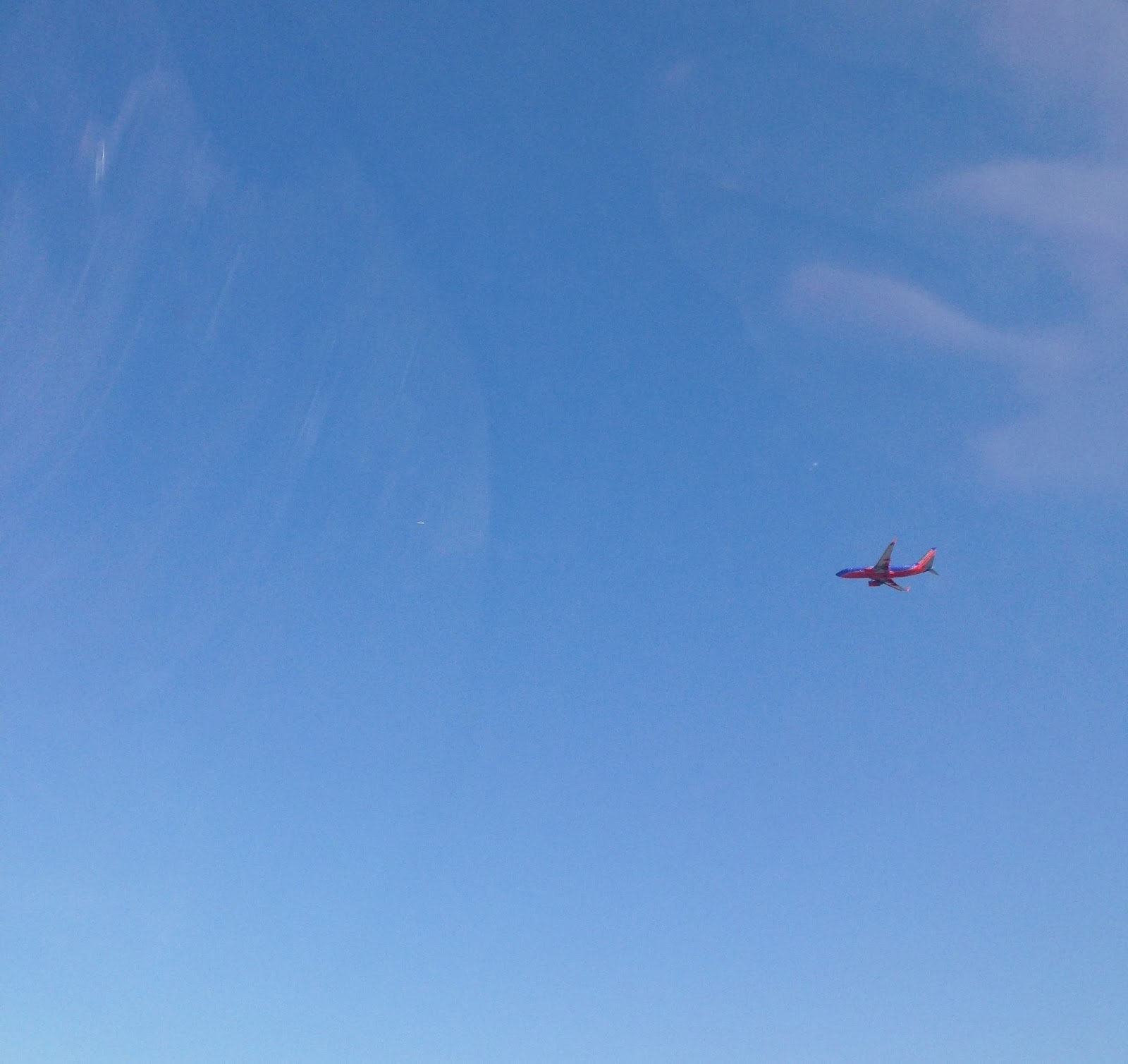
Southwest 737 crossing my path about 2,000 ft above and 1-2 miles away

                             
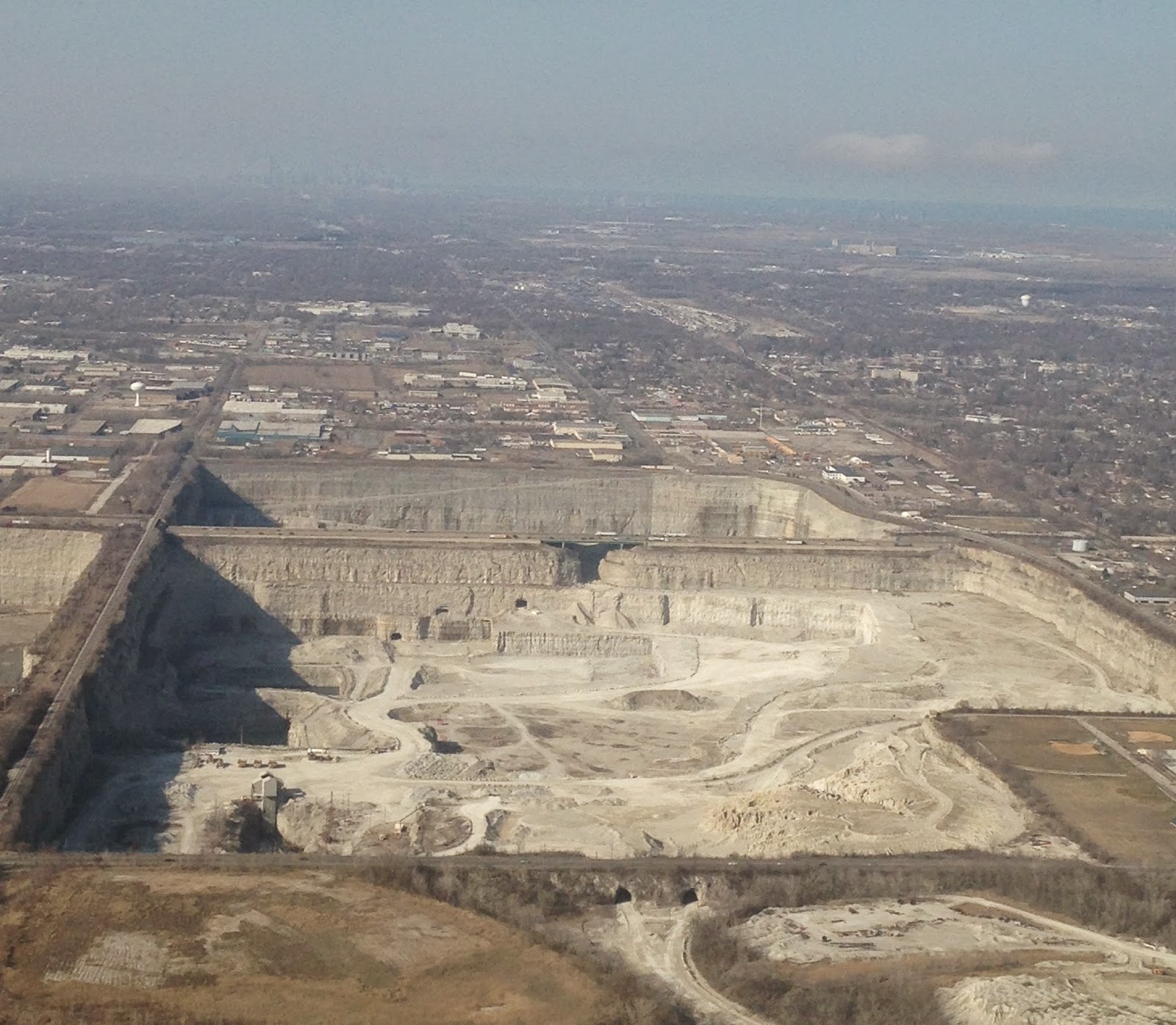
For those who make the trek from Illinois to the Indiana or Michigan side of Lake Michigan, here's what the big quarry along I-94 looks like from the air
Another view of the quarry, with I-94 cutting through the middle

The next day (Sunday) I went up with my instructor to practice some crosswind landings - some of the most difficult conditions that I've ever flown in. What that made me realize were the limits that I'll be comfortable taking myself up in as a licensed pilot, and also the limits that I'll have when carrying passengers as well...because scaring off passengers in dangerous weather conditions is no way to get them interested, or maintain their interest, in flying.

The rest of the week (Monday through Friday), I tried to schedule my longer cross country flight (which I needed to complete my 5 total cross country hours). However, Mother Nature didn't quite cooperate with me, as winds were almost always greater than 12 knots, sometimes gusting, which is well above my limits and therefore prohibited me from flying.

Saturday was a much different story. For the first time all week, winds were at 7 knots or below and the skies were crystal clear, which would have been perfect for some flying! Sadly, some others had the same idea that I did when I tried to schedule a Saturday time block, as almost all of the Saturday slots were already rented by other pilots. Even if I were able to get my flying in on Saturday, I'd be waiting until I got back from school for the summer to go on a checkride and officially get my license. While it's unfortunate, I guess it just wasn't in the cards for me this time and I'll just have to keep playing this waiting game.

In my next post, I'll talk about how the weather changed on me unexpectedly before landing back at 1C5 during that cross country flight to and from Valpo.

Friday, March 20, 2015

Back In The Saddle!

Very quick post today...

It's about that time! Spring break is finally here - definitely something that I've been looking forward to for these past few weeks. Not only does spring break mean getting to spend time with family or friends, but it also means (at least for me) that I get the chance to fly again, which I'm really pumped about!

A few days ago, the weather was looking promising for the weekend back home in Chicago so I decided to schedule some time to get back into the groove (and hopefully get my license while I'm at it!). As of now, I'm scheduled to go up with my instructor tomorrow from 10-12 and solo from 2-4. The reasoning behind flying with the instructor is that I can only go so long between flights before I need to be checked again. This means that tomorrow, I'll have to go through most, if not all, of the training points with him before I'm certified to do solo training flights again. If all goes according to plan from 10-12, I plan on getting some solo cross-country hours out of the way (5 needed for my license) in the afternoon block from 2-4. Very exciting!

Until then, I'll be sitting in the Albany, NY airport (where I'm currently typing this) waiting for my flight home and then spending time with my family later tonight before flying in the morning tomorrow. The weather frankly isn't looking promising for Monday, Tuesday, OR Wednesday of this upcoming week...so hopefully the forecasters are wrong and I'm able to get all of the flying I need to get this license! Keeping my spirits up about it - at the very least, I'll have a nice relaxing break spending time with my family.

Look for another post in a few days (hopefully) on the progress of my flying! Here's to hoping everything goes according to plan this week.

Saturday, March 14, 2015

Coming Home, Coming Home

Growing up and traveling with family and/or friends, we've all had that one commercial airport we somewhat identify with, as it's where many of our journeys have started - a gateway to good times if you will. For me, that gateway is Chicago's Midway Airport (MDW). Yes, many of you in the Chicago area know that MDW is a Southwest Airlines haven, whisking people all over the country in their shiny blue 737's. However, many of you may have not seen any small planes like mine ever flying into MDW, yet it happens on a daily basis.

...In fact, I flew in there myself! During part of my training back in January, I had to complete a night 'cross-country' flight (greater than 100 miles round trip) with my instructor. We also had to make the flight about 2.2 hours in length in order to fulfill my time requirement as well. The flight was planned from Clow Airport, Bolingbrook, IL (1C5) to Starke County Airport, Knox, IN (OXI). Along our route, there were winds that pushed us there at about 150 MPH - about 40 MPH faster than usual. As a result, we got there earlier than normal.

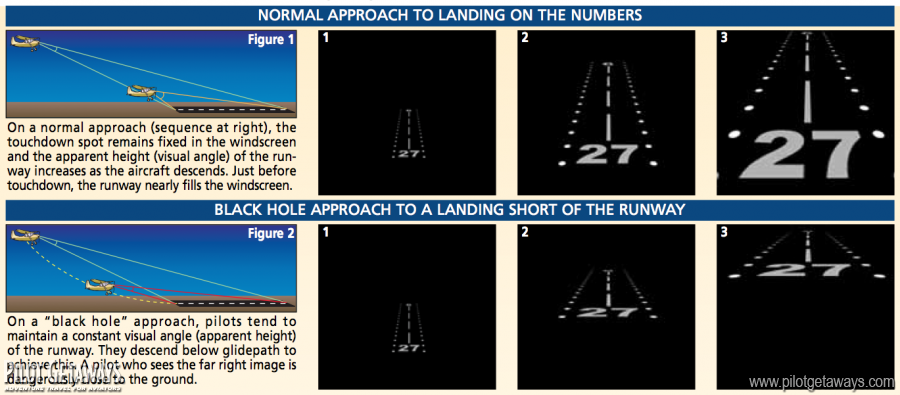
While at OXI, we performed a 3-4 takeoffs and landings, again to meet the requirements for training. Something pretty interesting that I got to experience at OXI was the "Black Hole Effect." Around the airport, there is nothing but farmland, and at night, the only lights for a mile or so around are the relatively bright runway and approach lights. As you can see below, a Black Hole approach could result in landing below the glidepath and possibly crashing, which thankfully didn't happen in my case. Definitely glad that I got to experience this phenomena with an instructor before experiencing it myself.


On the way back to 1C5, those same winds that gave us a 40 MPH boost on the way there were slowing us down by 40 MPH on the way back. While on the way back, my instructor and I calculated our estimated time of arrival back to 1C5, which would put me short of the hours that I needed to complete my night training. It was then that we decided to have a little fun and see if we could stop at MDW on our way back. Even though it would be a small detour, it would not only be a lot of fun, but give us the sufficient amount of hours as well.

En route to MDW, we needed to tune the radio to the ATIS, or Automated Terminal Information System - basically a robotic voice that played the current weather and different runways in use, After that, when approximately 15 miles away from the airport, I called up the control tower. When calling, I had to state the registration number of my aircraft (N72662), the aircraft type (Cessna 172), our location and altitude (15 miles SE, 3000 ft), the current weather information that we had (information India), and our intentions (the option to either land or perform a touch-and-go). From there, he told me to stay at or below 2000 ft and assigned me what's called a squawk. A squawk is a 4 number code that we have to enter into our transponder on the plane so that we are visible to the controller on his radar.

As we continued on our way, getting lower and lower over the city, we were able to see all of the Southwest jets and other private jets taking off and seemingly heading straight for us before climbing up thousands of feet above us. As we got within about 5 miles of MDW, the controller told us to follow the approach path to fly straight over the airport at 1,500 ft. My instructor and I were excited to say the least, because we would be given a view of the airport that you don't regularly get. It was also when we got within 5 miles that the air began to get pretty turbulent. We were low enough where the winds that were deflecting off of the houses and buildings right below us were buffeting our plane around a decent, but very manageable, amount.

Believe it or not, it was incredibly hard to spot the airport from a couple miles out - I was actually very surprised...not sure how commercial pilots do it on a daily (or nightly??) basis. Personally, I blame the orange street lights used by the City of Chicago, but that's a rant for another day...

Picture of the gate concourse area at MDW taken by my instructor. The two bright white lights above the two green lines are the wings of a taxiing Southwest 737
After flying over the field at 1,500 I made a relatively tight right turn to set myself up for final. We were assigned a touch-and-go on the runway parallel to what the big jets were using, so I had to be careful not to swing my turn out too close to their path. A private jet actually took off on the runway parallel to mine maybe 30 seconds before I landed, so the controller warned me of the wake turbulence as a result. Wake turbulence is what happens when vortices come off of plane's wings when they create lift - they actually have the power to flip smaller planes like mine and essentially drive them into the ground. After the touch-and-go, we headed directly back to 1C5 flying down I-55, literally and figuratively flying by the cars on the highway below.

Night flying, especially night flying into a busy commercial airport like MDW, is definitely something special, and something that can provide incredible views that not many other people get to experience. I can't wait until the day that I'm fully licensed so I can take my family and friends around at night, and hopefully into MDW and along the Chicago shoreline! I'd love to take any of you...

Route of the Above Flight

Hope you all enjoyed this post! Next week (3/21 - 3/28), I plan on (weather permitting) finishing my license while I'm on my spring break. More to come in the following days on the progress of that!

Happy flying!